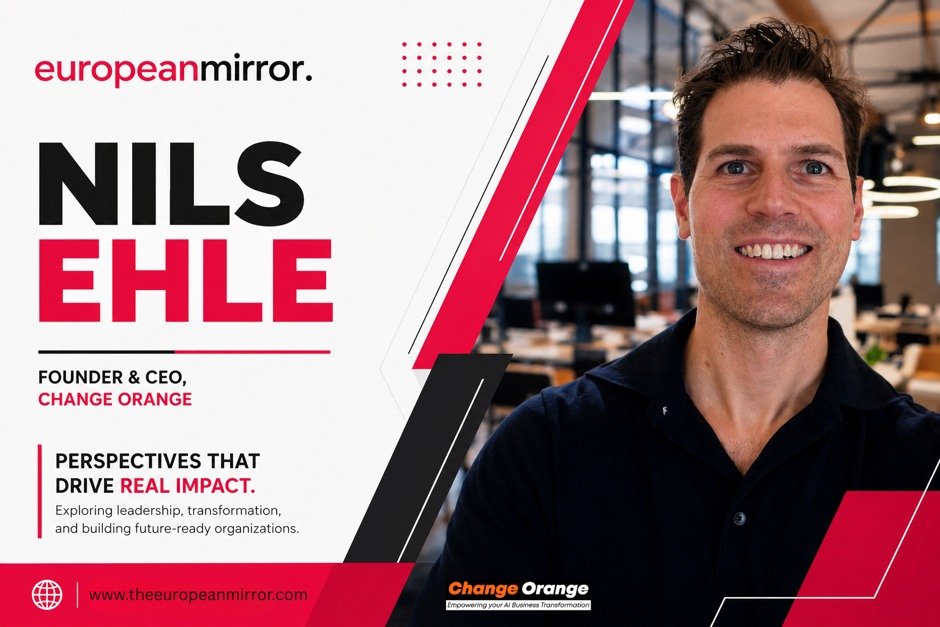
Long before AI business transformation became a boardroom priority across the continent, Nils Ehle was already building the networks and frameworks that would define his approach to it. As Founder & CEO of Change Orange, his European career, spanning consulting, energy, and regional innovation, has shaped a practice now known for putting people ahead of technology.
An Education in European Industry
Nils Ehle began his career at Accenture before joining E.ON, one of Europe’s largest energy companies, where he moved from IT transformation into the operational side of the sales business. “Technology was still treated largely as an IT domain and rarely delivered what the business actually needed,” Nils Ehle recalls of that period, a gap that would come to define much of his later work.
In 2012, Nils Ehle was given the freedom to build an international transformation unit spanning 12 country markets, reporting directly to board level. That mandate led to one of the more distinctive projects of his career: helping build a cross-company innovation hub in Germany’s industrial heartland, the Ruhr Valley, bringing together roughly 80 organizations, corporates, startups, universities, and public institutions, including direct competitors of his own employer. The focus was regional digital transformation, matching the right emerging solutions to the right business problems while helping companies adapt their culture along the way.
By 2015, that work had grown into Change Orange, founded initially as a boutique consultancy focused on customer-centric redesign. Today it is fully dedicated to AI business transformation across industries, delivered, in Nils Ehle’s words, in a human-first way. That includes AI strategy development, end-to-end AI business transformation, business model and operating model redesign, workforce capability building, and the change management that keeps European firms from stalling once the strategy phase ends. “None of these pieces work well in isolation,” Nils Ehle says. “Strategy without operating model change stays theoretical. Operating model change without capability building doesn’t last.”
A European Model for AI Readiness
Nils Ehle is skeptical of the pressure many European companies feel to demonstrate rapid AI wins. “Many organizations jump straight into use cases, chatbots, copilots, isolated proofs of concept, and months later wonder why nothing has scaled,” he says. His answer is Change Orange’s six-dimensional AI Business Maturity Model, covering data, technology infrastructure, organizational process, team skill, strategic alignment, and leadership culture. “AI is the current trigger,” he says. “The capabilities you build are the lasting muscle.”
Notably, Nils Ehle points out that only two of the six dimensions concern AI directly. “The other four have nothing to do with AI as such. They are about core organizational strength,” he says, framing resilience, not novelty, as the real objective of transformation work.
Leadership Reimagined for a VUCA Plus Continent
As AI takes over more of the managerial workload across European firms, Nils Ehle argues leadership itself is shifting. “That’s a big shift, from the management of tasks to the leadership of people,” he says. His seven-dimensional leadership model spans willingness to learn, emotional intelligence, data fluency, adaptability, systemic thinking, creativity, and courage to change.
He often illustrates this with the image of the elephant, whose heart weighs roughly five times more than its brain, the reverse of the human ratio. “Most modern leadership is built on that imbalance, heavy on analysis, light on heart,” Nils Ehle says. “The leaders succeeding now are shifting deliberately toward heart-based leadership, making decisions from a place of care, not just calculation.”
A German Case Study in Change That Sticks
Among his proudest projects, Nils Ehle points to the redesign of a global pharmaceutical company’s digital supply chain, executed by placing people into new roles immediately and running the change from within rather than planning it on paper first. Within a year, the organization had fully transformed. “Not a deck on a shelf, but a working organization run by empowered people,” he says.
Building Products, Not Just Frameworks
Beyond consulting, Nils Ehle has partnered on AI Use Case Engine, a system that maps a company’s business capabilities and proposes, benchmarks, and prioritizes AI and automation use cases against real-world precedent. He describes it as deliberately combining narrow artificial intelligence with human judgment, what he calls general human intuitive intelligence.
People First, Not AI First
“Many organizations say AI first. I think that’s the wrong mantra,” Nils Ehle says. “The right mantra is people first, lived from the heart.” Citing MIT Media Lab research on cognitive debt, he warns that leaning too heavily on AI can quietly erode people’s own thinking. “The biggest risk is not AI itself. It’s humans giving up their own potential.”
The Advice Behind the Practice
Asked what shaped his path, Nils Ehle rejects the word career altogether. “I prefer to call it an experience path,” he says. “Do not follow a career path. Follow your path.” He adds: be authentic, be honest, build things together, and refuse to let fear make decisions.
Staying Grounded Across a Continent of Clients
With a practice spanning multiple countries, Nils Ehle credits time away from screens, playing the handpan, running, and time in nature with family, as essential to his thinking. “New ideas rarely arrive when you’re staring at the problem,” he says. “They arrive when you’ve stepped away.”
Nils Ehle delivers keynotes across Europe on leadership in the age of AI and building organizations for AI readiness. Learn more about his work at Change Orange at www.changeorange.com. Also check: LinkedIn, X, YouTube, and TikTok.
Also Read:-
The Power List: 10 Leaders Shaping Tomorrow’s World | Top Leaders